 Fall Special Offer

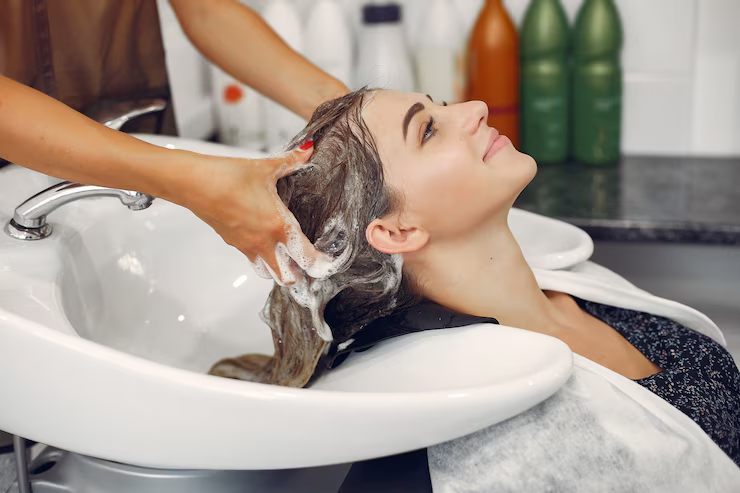
For the estimated 15-20% of Canadians who experience some form of sound sensitivity, misophonia can feel like living in a world where everyday sounds become overwhelming triggers. From the gentle crunch of cereal at breakfast to the rhythmic tapping of a colleague’s pen, these seemingly harmless noises can provoke intense emotional and physiological reactions that disrupt daily life.
However, emerging research and clinical practice are revealing that head massage therapy may offer a surprisingly effective pathway to relief—not by eliminating trigger sounds, but by fundamentally changing how our nervous system responds to them.
Understanding Misophonia: Canada’s Hidden Sound Sensitivity Challenge
Misophonia is not very well known yet throughout the medical community. Yet it appears to be more common than you may think. “It’s an unknown disorder, but it’s a really hidden epidemic because the prevalence, I think, is pretty high”, explains Amsterdam-based psychiatrist Damiaan Denys, who co-authored groundbreaking research on this condition.
What Makes Misophonia Different from Other Sound Issues
Unlike general noise sensitivity or hearing problems, misophonia involves a very specific reaction pattern. Misophonia is an extreme emotional and physical response to seemingly innocuous, repetitive sounds like chewing, lip-smacking, and even breathing. People with the condition experience a fight-or-flight response to these noises, along with physical tension, disproportionate anger, and hatred or disgust toward the person responsible for the triggering noise.
Canadian research indicates that humans make most of the sounds and sights that trigger misophonia. A dog slurping down a bowl of food or similar does not usually provoke a misophonic reaction. When a person with misophonia hears a trigger sound, these sounds trigger the person’s fight/flight response.
The Canadian Experience of Living with Misophonia
“I was 9 years old, sitting on the couch at home watching a movie with my mother and my brother Sam. They were eating potato chips that Sam had chosen as his movie-night snack. The sound of them eating chips was so painful, I wanted to run away and cry in my room”, recalls Ann, a Canadian patient whose story illustrates the early onset typical of this condition.
The impact extends far beyond personal discomfort. In severe cases, people who suffer from the selective sound sensitivity known as misophonia will quit their jobs because of it. Others may actually divorce</cite>. The isolation can be particularly challenging during Canada’s long winter months when families spend more time indoors together.
The Science Behind Head Massage and Sound Sensitivity Relief
Recent advances in neuroscience are revealing why head massage can be so effective for managing misophonia symptoms.
How Head Massage Affects the Nervous System
Head massage effects by stimulating nerve endings in the scalp, increasing blood circulation, and relieving the tension that builds up in the head, neck, and shoulders. They offer physiological responses such as relaxation and decreased cortisol (stress hormone).
This is particularly relevant for misophonia because stress is a major contributor to headaches and migraines, and head massages can be an effective way to reduce stress levels. Massage is believed to reduce stress by reducing cortisol (a stress hormone) levels in the brain and increasing the parasympathetic nervous system, an automatic calming mechanism.
The Progressive Muscle Relaxation Connection
The most promising treatment approach for misophonia involves Progressive Muscle Relaxation (PMR), and head massage naturally incorporates many of these principles. The main benefit for Misophonia is that it lets you relax your muscles on demand. You can only do this after you have developed the skill of relaxing your muscles.
We find that anger has a physiological component to it of tense muscles. And so if I’m angry (mentally), but my muscles are relaxed, it plays a trick on your brain. Those are inconsistent events. Tight muscles go with anger; relaxed muscles go with calm.
Head Massage Techniques Specifically for Misophonia Management
The Temple Focus Method
Targeted specifically at the temples, this technique works wonders on stress-induced headaches. Applying gentle pressure can soothe chaotic thoughts and provide immediate relief For Canadians with misophonia, this technique is particularly valuable during trigger situations.
How to perform:
- Place fingertips gently on both temples
- Apply light, consistent pressure while making small circular motions
- Breathe deeply and focus on releasing muscle tension
- Continue for 2-3 minutes or until you feel your fight-or-flight response diminishing
Scalp Circulation Enhancement
A 2016 study also found that both 15- and 25-minute scalp massages could decrease systolic and diastolic blood pressure in female participants. The authors of the study believe this may be because a head massage can help promote blood circulation, which has a positive effect on the relaxation of blood vessels and neck muscles.
This physiological change is crucial for misophonia management, as it directly counteracts the stress response triggered by problem sounds.
The Neck and Shoulder Release
An extension of head massage, targeting the neck and shoulders can reduce the buildup of tension that contributes to stress, ensuring full-body relaxation. This area, often overlooked, serves as a reservoir for accumulated stress thanks to an entire day’s worth of postures and micro-movements.
Integrating Head Massage into Daily Misophonia Management
Morning Preparation Routine
Starting your day with a 5-10 minute head massage can help establish a calm baseline that makes trigger sounds less overwhelming throughout the day. For optimal results, aim to perform your head massage for a minimum of 5 minutes every day. Consistency is key to reaping the many head massage benefits, such as hair growth, reduced tension, and improved mood.
Workplace Strategies for Canadian Professionals
With many Canadians working in open office environments or from home, trigger sounds are often unavoidable. Ear reflexology can be complemented by gentle earlobe rolling. This subtle addition enhances the stimulation of points connected to the shoulders, neck, and even the jaw, areas prominently affected by stress tension.
This technique is discreet enough to use during meetings or at your desk without drawing unwanted attention.
Evening Wind-Down Protocol
Taking time out for a relaxation head massage allows individuals to be present and focus on self-care. In 2025, mindfulness is a key aspect of stress management, and head massages help people reconnect with their bodies and minds.
The 2025 Head Spa Revolution and Misophonia Relief
The growing popularity of head spa treatments across Canada presents new opportunities for those managing misophonia.
Professional Treatment Options
Many Canadian spas are now incorporating specialized techniques for sound sensitivity management. Indian Head Massage, also known as Champissage, is a holistic therapy that focuses on the upper body, including the head, neck, shoulders, and arms. It involves applying pressure and manipulating soft tissues to relieve tension and improve blood circulation.
At-Home Solutions for Canadian Winters
During Canada’s long winter months, when indoor family time can be particularly challenging for those with misophonia, at-home head massage techniques become essential. Using very firm pressure and a tiny circular motion, gradually move your fingers up along your hairline until they meet in the middle of your forehead, massaging your entire forehead and scalp as you inch along.
Evidence-Based Results: What Research Shows
Treatment Effectiveness
Progressive muscle relaxation (PMR) is a relaxation technique that involves tensing and then releasing muscle groups throughout the body. Hence, people can practice identifying their physical responses to misophonic triggers, both before and after being triggered. Using PMR regularly can reduce the intensity of both the emotional and the physical reactions.
Cognitive Behavioural Integration
Cognitive Behavioral Therapy and progressive relaxation are both effective treatment methods for misophonia. In addition, a modality called Neural Repatterning Technique (NRT) pairs low-level triggers with a pleasant sensation, as a way to reduce the physical response to the misophonic trigger.
Head massage naturally incorporates elements of both approaches, making it an ideal complementary therapy.
Practical Implementation for Canadian Families
Supporting Children with Misophonia
According to Denys, in roughly 50 to 60 per cent of cases, misophonia starts when a person is between the ages of nine to 13 and sitting at the dinner table with parents. And suddenly, the sound of their eating becomes unbearable.
Teaching children gentle self-massage techniques can provide them with tools for self-regulation before emotional reactions escalate.
Creating Trigger-Friendly Environments
Add sounds to your environment: We find that the misophonic trigger response is more intense when the trigger sound is the only noise and thus, adding sounds to your environment will in fact reduce the trigger sound and reduce the overall severity of the trigger response.
Combining this environmental management with regular head massage creates a comprehensive approach to symptom management.
Advanced Techniques: The Professional Advantage
Specialized Equipment and Approaches
This is full head massager that targets the scalp, temples, brow ridge, and neck using acupressure and vibration massage. It has 10 fingertip-shaped nodes that provide five massage functions at different intervals to replicate the sensation of a professional masseuse.
While professional-grade equipment can enhance the experience, the basic principles remain accessible through manual techniques.
Sound Therapy Integration
Both George and Ann have used sound-based therapy to manage misophonia. They were fitted with Widex hearing instruments programmed with white noise and Zen tones, intended to distract from and ultimately acclimatize to trigger sounds.
Head massage can be effectively combined with sound therapy approaches for enhanced benefits.
Looking Forward: The Future of Misophonia Management in Canada
Research and Development
Canadian researchers are at the forefront of misophonia research, with recent thinking on the mechanistic basis of misophonia, with a focus on moving towards neurologically-informed treatment approaches.
Accessibility and Healthcare Integration
As awareness grows, more Canadian healthcare providers are recognizing the need for comprehensive misophonia management. Additional opportunities for audiological education and interdisciplinary collaboration with providers from the fields of mental health are much needed.
Conclusion: Taking Control Through Touch
Living with misophonia in Canada doesn’t have to mean accepting isolation or constant stress. Head massage therapy offers a practical, evidence-based approach that empowers individuals to take control of their nervous system response to trigger sounds.
The beauty of this approach lies in its accessibility—while professional treatments can enhance the experience, the fundamental techniques can be learned and applied anywhere, anytime. Whether you’re dealing with the crunch of morning cereal, the sounds of office life, or the challenges of family gatherings during long Canadian winters, head massage provides a pathway to greater peace and improved quality of life.
Ready to explore how head massage can transform your relationship with sound sensitivity? Book your specialized consultation at Head Spa Toronto and discover personalized techniques for managing misophonia through therapeutic touch.